
1 · Board and objective
Set up twelve houses and 48 seeds
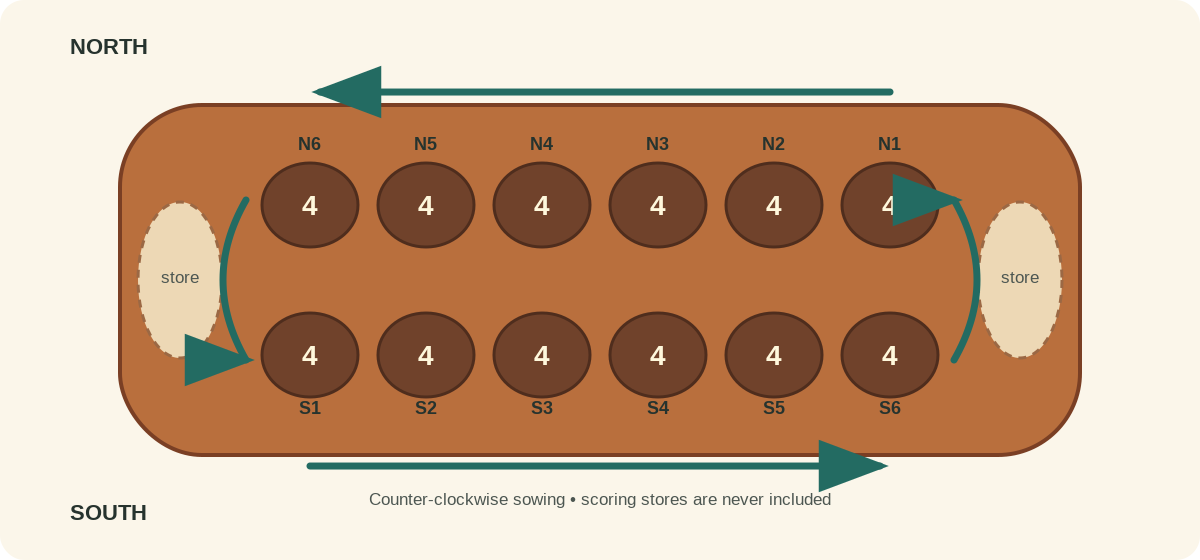
Place four seeds in each playable house. Each player owns the six houses nearest them. That fixed six-house row is the player's territory. Captured-seed stores may hold the score, but they are not playable houses and are always skipped. The glossary distinguishes a playable house from a scoring store.
Choose the first player by agreement or lot. For digital abapa.v1, selecting and persisting that starter before the initial position is a platform convention.
This guide uses stable logical seats: South owns S1–S6 and North owns N1–N6. From South's viewpoint the single sowing track is:
S1 → S2 → S3 → S4 → S5 → S6
N1 → N2 → N3 → N4 → N5 → N6 → S1
The route is counter-clockwise. The object is to capture more seeds than your opponent.
2 · One complete turn
Lift the whole hand and sow once
- Choose a non-empty house on your own row, subject to the feeding rule.
- Lift every seed from that source house.
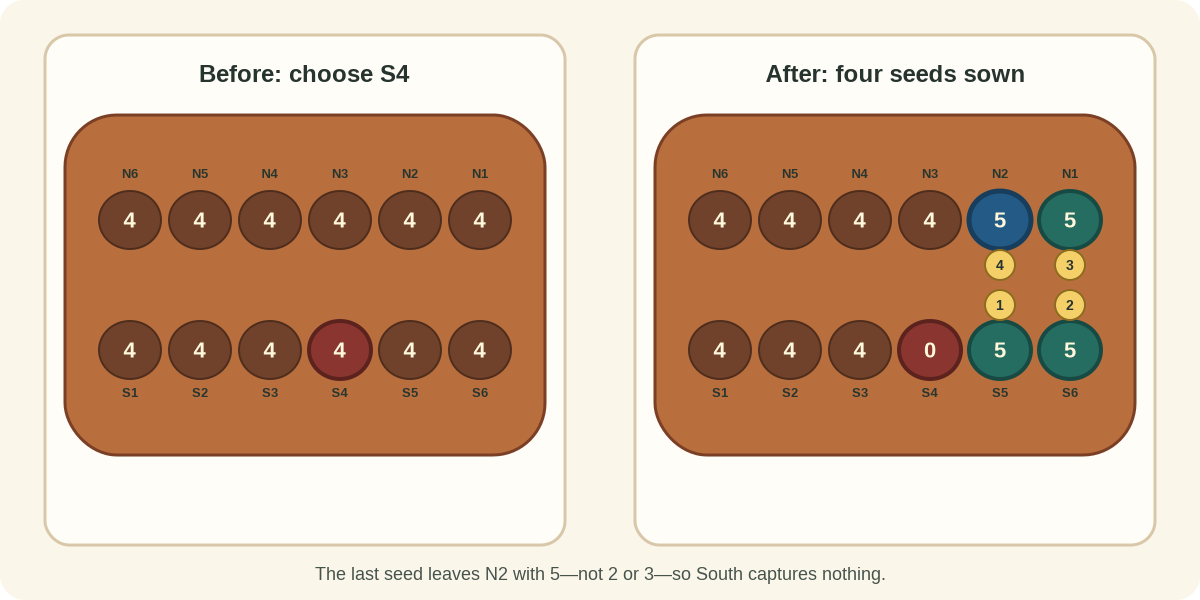
- Sow by dropping one seed into each following playable house, counter-clockwise.
- Resolve one possible capture chain from the final landing house.
- Check the ending rules, then pass the turn if play continues.
Abapa uses one sowing hand. It does not relay-sow by picking up the landing house.
Multi-lap rule
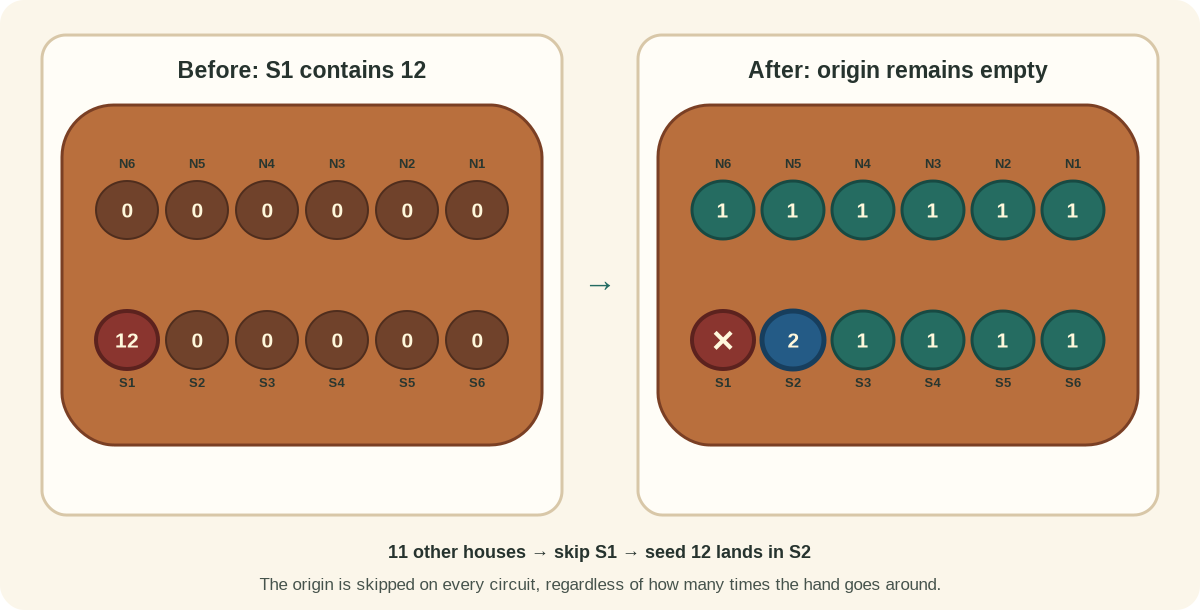
Skip the source on every circuit
When a hand travels all the way around the board, leave the source house empty whenever the route returns to it. Continue with the following house. The same skip applies again on every later circuit.
3 · Capture
Start at the landing house and work backward
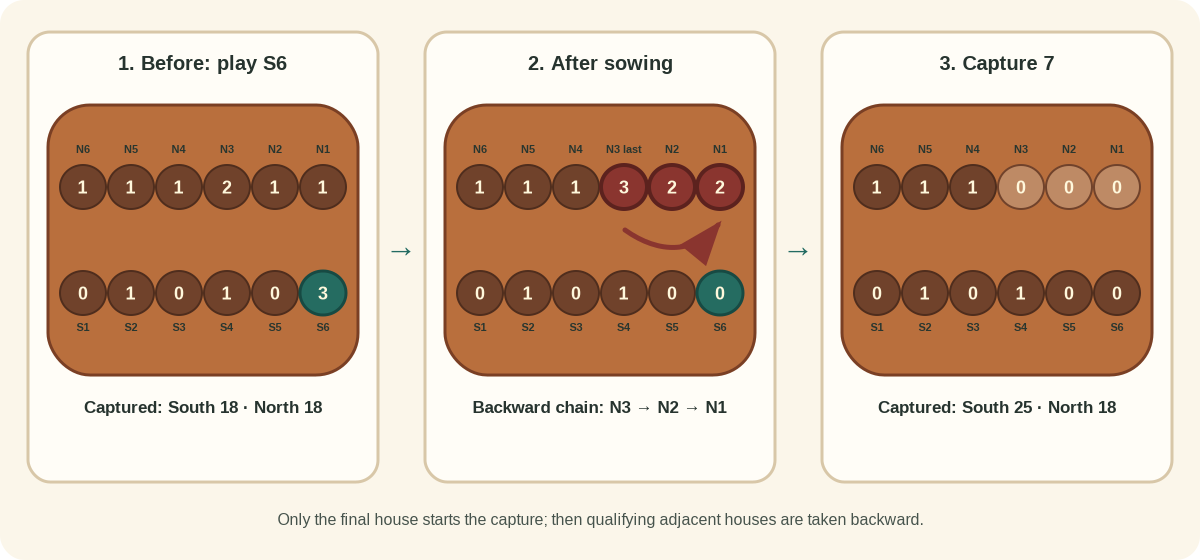
A capture begins only if the final seed lands on the opponent's row and makes that landing house contain exactly two or three seeds.
- Capture every seed in that landing house.
- Move backward against the sowing direction through adjacent opponent houses.
- Continue while each house contains exactly two or three.
- Stop at 0, 1, 4 or more, or the edge of the opponent's row.
- Never jump a gap or continue into your own row.
An earlier drop that made a house contain two or three does not start a capture by itself.
4 · Feeding and starvation
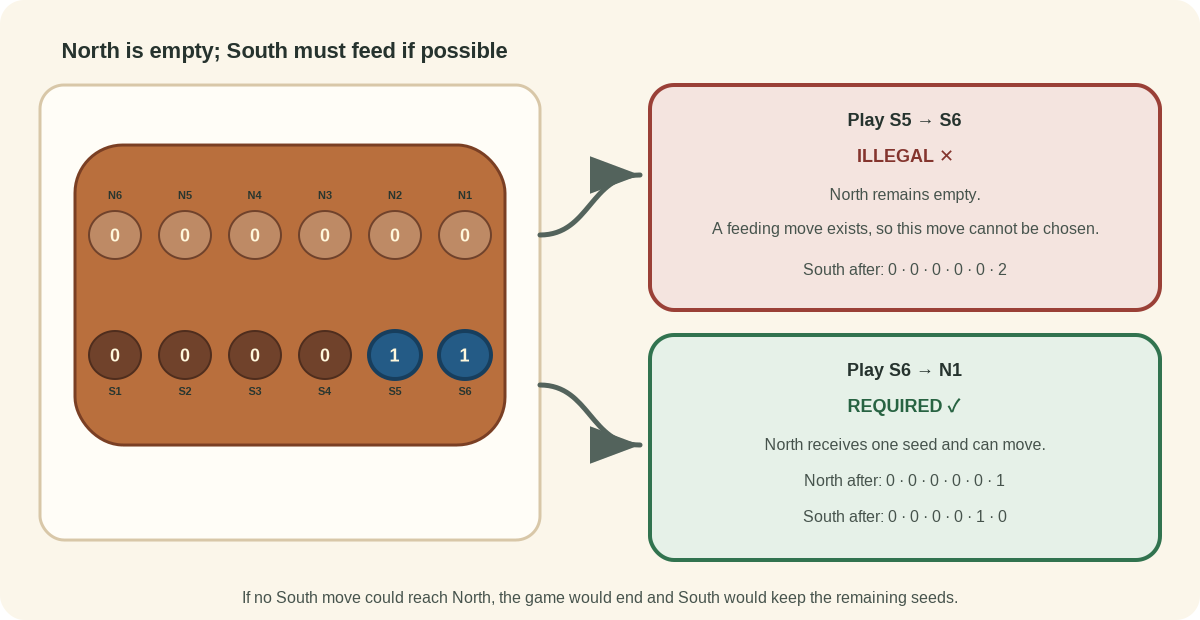
Give an empty opponent a move when possible
The feeding rule applies when the opponent's row is empty. If the opponent still has seeds, play normally. If their row is empty, you must choose a move that places at least one seed into it whenever any such move exists. A non-feeding move is then illegal.
If the opponent's row is empty and no legal source can reach it, no sowing move is made. The current player takes the seeds remaining on their own row, and the final captured totals are compared.
5 · Grand Slam protection
Keep the sowing; cancel the whole capture
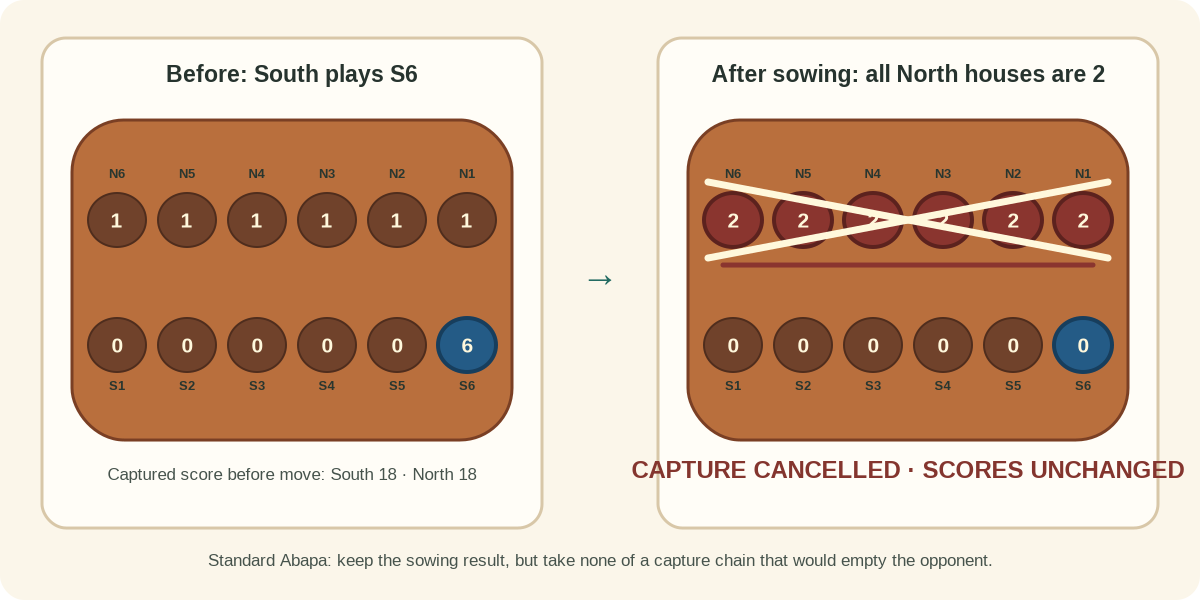
A Grand Slam is a candidate capture chain that would remove every seed remaining on the opponent's row. In abapa.v1, the sowing move remains legal, but the entire capture is cancelled. All opposing seeds stay in their houses.
Do not take only part of the chain to leave a seed behind. Alternative Grand Slam consequences belong to separately identified traditions and are not options in this playable profile.
6 · Ending and scoring
Compare captured totals
Majority
A player who captures at least 25 seeds wins, and play ends immediately.
Equal score
A captured total of 24–24 is a draw.
Impossible feed
The current player takes the seeds left on their own row, then final totals decide the result.
Repeated position
The digital profile settles a third occurrence as described below. See the position definition.
Player glossary
Rules terms at a glance
These definitions use the same terminology as the abapa.v1 rules contract. Follow the dotted links in the guide to jump here.
- House
- One of the twelve playable seed containers on the board.
- Store
- An optional score container. It is never a playable house and is skipped while sowing.
- Territory or row
- The six houses permanently owned by one logical seat: South or North.
- Source house
- The non-empty house on your row whose entire contents you lift to start a move.
- Sow
- Place the lifted seeds one at a time along the counter-clockwise track, skipping the source on every return.
- Landing house
- The house that receives the final seed. Only this house can begin a capture chain.
- Capture chain
- The qualifying landing house and contiguous opponent houses collected backward while each contains exactly two or three seeds.
- Feeding move
- A move that places at least one seed into an empty opponent row. It is compulsory whenever one is possible.
- Grand Slam
- A candidate capture that would empty the opponent's row. In
abapa.v1, the sowing remains but the whole capture is cancelled. - Captured total
- Seeds already scored by one seat and no longer present in any house.
- Position
- A stable rules state. For repetition, all twelve house counts, both captured totals, and the side to move must match.
- Settlement
- Moving remaining row seeds into captured totals after an impossible feed or repeated position ends the game.
Documented Oware family
Informational profiles, not playable modes
Names do not identify rules reliably. These summaries preserve documented differences and open edges. They do not enable another engine, preset, or hidden rules switch in this prototype.
The Antigua Academy / international Warri teaching profile follows Abapa and can retain abapa.v1 with Warri terminology. It is not a separate enabled rules engine. The word “Warri” alone must never select one of the distinct profiles below.
Reference only · not currently playable
Nam-nam
nam_nam
- Sowing model
- Relay sowing; a later relay treats the original house like any other house.
- Key difference from Abapa
- Capture houses that reach four and play across rounds with changing territory. Sources differ on starvation, and the territory boundary needs an explicit persisted convention.
Reference only · not currently playable
Tampoduo
tampoduo
- Sowing model
- Relay sowing continues until a final seed lands in an empty house.
- Key difference from Abapa
- Ending in an empty own house captures that seed and the seeds directly opposite. Traditional “meaningful play” endings need a published digital threshold.
Reference only · not currently playable
Warri — traditional Antiguan profile
warri_antigua_traditional
- Sowing model
- Abapa single-hand sowing with source skipping.
- Key difference from Abapa
- A reported tradition permits the full Grand Slam and, unless it wins, gives the capturer another feeding turn. It is not a claim about every Antiguan game.
Reference only · not currently playable
Warri — Barbados profile
warri_barbados
- Sowing model
- Abapa single-hand sowing with source skipping.
- Key difference from Abapa
- A documented profile permits the Grand Slam, then awards all seeds still on the board to the emptied opponent. Its consequence also differs from the reported Antiguan profile.
Reference only · not currently playable
Ouril / Uril — Cape Verdean profile
ouril_cabo_verde
- Sowing model
- Abapa sowing with a restriction on choosing a singleton while another own house has at least two seeds.
- Key difference from Abapa
- A source-scoped profile permits the Grand Slam and then requires a feeding turn. Island practice and some precedence edges vary or require an explicit implementation decision.
Reference only · not currently playable
Ourin compulsory-capture option
ourin_compulsory_capture
- Sowing model
- Uses the rules of an explicitly selected Ouril profile.
- Key difference from Abapa
- A separately documented subvariant requires a capturing move whenever one is available. It is not a universal Ouril rule and cannot be an unchecked toggle.
Research reference · not currently playable
Urim — reported Brava form
urim_brava_research_profile
- Sowing model
- Research evidence may use six or seven houses per row; a digital model is not settled.
- Key difference from Abapa
- A 2-or-3 chain may extend through preceding fours. Its edge cases are unresolved, so this remains a research profile rather than an implementation specification.
Source and evidence trail
Read the authorities behind this page
The repository rules guide was reconciled on 2026-08-03. Its prose and six diagrams are repository-authored; linked authorities support the factual rules. The digital contract makes platform choices explicit.
- Repository rules guide — OWARE_RULES.md
- Normative digital profile — abapa.v1
- Oware Society — Abapa rules
- TA Kofi — How to Play Oware (Abapa), corroborating demonstration
- Oware Society — rules-family overview
- Oware Society — Nam-nam rules
- Oware Society — Tampoduo rules
- Antigua and Barbuda Department of Culture — Rules for Playing Warri
- Barbados Warri rules
- Digital Ludeme Project — Uril
- University of Porto — John Conway + Ouri rules
- University of Coimbra — Regras do Jogo Ouri
This rules page is bounded implementation evidence. It is not an editorial approval, production asset clearance, localization, tutorial, assistive-technology or device test, accessibility-conformance result, support commitment, or release claim.